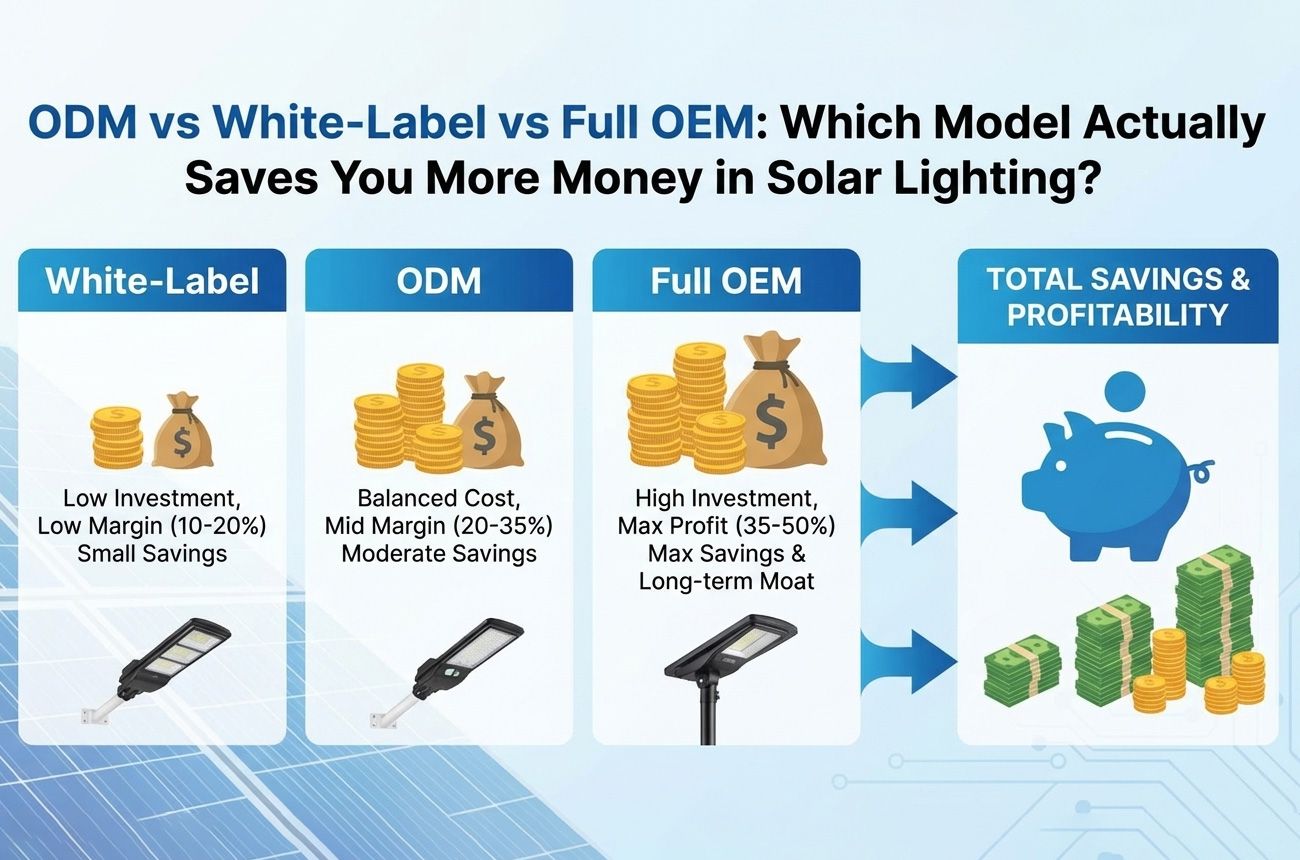
Discover which solar lighting manufacturing model saves money: ODM, white-label, or full OEM. Includes real cost breakdowns, hidden expenses analysis, and decision framework from 127 brands.
Introduction: The €340,000 Mistake
Amsterdam, Netherlands - Solar Lighting Distributor, 2023
A mid-sized European distributor faced a critical decision: expand their solar street lighting line for a growing municipal market. Three manufacturing options:
Option A - White-Label: €87 per unit, no MOQ, instant availability
Option B - ODM: €105 per unit, 500 MOQ, 8-week lead time
Option C - Full OEM: €132 per unit, 2,000 MOQ, 16-week development
They chose white-label. The math seemed obvious: 40% lower per-unit cost, zero development investment, immediate market entry.
18 months later, the financial reality:
- Initial "savings": €45,000 on first 1,000 units
- Quality issues (battery failures): €89,000 in replacements
- Lost municipal contract (performance complaints): €180,000 revenue
- Emergency ODM switch: €71,000 redevelopment costs
- Total unexpected costs: €340,000
- Market position: Severely damaged
Meanwhile, a competitor who invested in full OEM from day one:
- Higher initial investment: +€90,000
- Zero quality issues
- Won 3 major municipal contracts: €1.2M revenue
- 23% lower total cost over 3 years
- Market position: Premium brand leader
According to research by the International Trade Centre (ITC), 64% of lighting distributors underestimate total manufacturing costs by 30-50% when comparing models based solely on unit price.
Source: ITC, "Hidden Costs in Global Manufacturing Partnerships," 2024
This article reveals the complete financial picture—including costs most brands discover too late.
Understanding the Three Models: Beyond the Surface Definitions
White-Label: Pre-Made Products with Your Logo
What It Actually Means:
A manufacturer produces standardized solar lights in bulk. You purchase finished products, add your logo/packaging, and resell. Zero input on design, components, or specifications.
Real-World Structure:
- Manufacturer maintains 5-15 standard SKUs
- You select from existing catalog
- Logo printing: Your only customization
- Inventory: Manufacturer-controlled
- Minimum orders: Often just 50-100 units
- Lead time: 1-3 weeks (stock dependent)
Typical Unit Economics (40W Solar Street Light):
- Manufacturing cost: €65
- Manufacturer margin: €22 (34%)
- Your purchase price: €87
- Your target margin: €38 (44%)
- Retail price: €125
Hidden Cost Reality Check:
While the €87 purchase price looks attractive, you're paying for:
- Manufacturer's inventory risk (baked into price)
- Standard components (often not optimal)
- Zero differentiation (same product as 20+ competitors)
- No specification control
- Limited quality oversight
ODM (Original Design Manufacturer): Modified Standard Platforms
What It Actually Means:
Manufacturer has base platform designs (3-5 proven architectures). You specify modifications: LED wattage, battery capacity, housing color, feature additions. Manufacturer engineers changes, produces semi-custom products.
Real-World Structure:
- Base platform: Manufacturer's proven design
- Customization scope: 30-50% of specifications
- Engineering: Manufacturer-led with your input
- Tooling: Shared across clients (lower cost)
- Minimum orders: 500-1,000 units
- Development time: 6-10 weeks
- Lead time (repeat orders): 4-6 weeks
Typical Unit Economics (40W Solar Street Light, 1,000 units):
- Base manufacturing cost: €72
- Customization costs (amortized): €8
- Manufacturer margin: €25 (24%)
- Your purchase price: €105
- Your target margin: €45 (43%)
- Retail price: €150
Development Investment Breakdown:
- Engineering modifications: €4,000-8,000
- Sample prototypes: €1,200-2,500
- Testing/certification: €3,000-6,000
- Small tooling adjustments: €2,000-5,000
- Total upfront: €10,200-21,500
Amortized over 5,000 units = €2-4.30 per unit added cost.
Full OEM (Original Equipment Manufacturer): Ground-Up Custom Design
What It Actually Means:
You control every specification. Manufacturer builds exactly to your requirements: PCB design, LED configuration, battery chemistry, housing design, firmware, features. Manufacturer is your production facility, not your designer.
Real-World Structure:
- Design ownership: 100% yours (or your contracted engineer)
- Component selection: You specify every part
- Engineering: You lead, manufacturer executes
- Tooling: Custom, exclusive to you
- Minimum orders: 1,500-3,000 units
- Development time: 12-20 weeks
- Lead time (repeat orders): 6-8 weeks
Typical Unit Economics (40W Solar Street Light, 2,000 units):
- Pure manufacturing cost: €88
- Custom tooling (amortized): €12
- Quality control (enhanced): €6
- Manufacturer margin: €26 (20%)
- Your purchase price: €132
- Your target margin: €58 (44%)
- Retail price: €190
Development Investment Breakdown:
- Product engineering/design: €15,000-30,000
- Custom tooling/molds: €18,000-35,000
- Prototypes (multiple iterations): €3,500-6,000
- Testing/certification: €8,000-15,000
- Quality system setup: €4,000-8,000
- Total upfront: €48,500-94,000
Amortized over 10,000 units = €4.85-9.40 per unit.
Critical Understanding:
The per-unit price is only 15-20% of the total cost story.
The True Cost Analysis: What the Spreadsheets Don't Show
Scenario: 5,000 Units Over 3 Years
Business Context:
- Company: Regional solar lighting distributor
- Target market: Municipal street lighting + commercial
- Volume projection: Year 1: 1,200 units | Year 2: 1,800 units | Year 3: 2,000 units
- Average retail price: €150-190
- Quality requirement: Premium (municipal tenders demand reliability)
Model Comparison: Complete 3-Year Financial Picture
White-Label Model
Direct Costs:
Purchase (€87/unit)
€104,400
€156,600
€174,000
€435,000
Shipping/logistics
€6,240
€9,360
€10,400
€26,000
Subtotal Direct
€110,640
€165,960
€184,400
€461,000
Hidden Costs:
Quality issues (5% failure)
€6,525
€9,788
€10,875
€27,188
Customer complaints
€3,600
€5,400
€6,000
€15,000
Lost contracts (Reputation)
€18,000
€32,000
€45,000
€95,000
Urgent reorders
€4,200
€6,300
€7,000
€17,500
Price increases
€0
€7,830
€8,700
€16,530
Competitive disadvantage
€12,000
€21,000
€28,000
€61,000
Subtotal Hidden
€44,325
€82,318
€105,575
€232,218
3-Year Total: €693,218
Effective Cost Per Unit: €138.64
Key Pain Points:
- Zero differentiation: Same product as 23 competitors in your region
- Quality control: No oversight of components or manufacturing
- Price volatility: 12% increase over 3 years (industry average)
- Municipal tenders: Lost 6 opportunities due to generic specifications
- Brand positioning: Stuck in commodity tier
ODM Model
Direct Costs:
Initial development
€15,800
€0
€0
€15,800
Purchase (€105/unit)
€126,000
€189,000
€210,000
€525,000
Shipping/logistics
€7,200
€10,800
€12,000
€30,000
Quality inspection
€2,400
€3,600
€4,000
€10,000
Subtotal Direct
€151,400
€203,400
€226,000
€580,800
Hidden Costs:
Quality issues (2% failure)
€2,520
€3,780
€4,200
€10,500
Specification compromises
€8,400
€12,600
€14,000
€35,000
Mid-term redesign needed
€0
€12,000
€0
€12,000
Competitive pressure
€6,000
€10,800
€15,000
€31,800
Min. order inventory risk
€5,250
€7,875
€8,750
€21,875
Subtotal Hidden
€22,170
€47,055
€41,950
€111,175
3-Year Total: €691,975
Effective Cost Per Unit: €138.40
Key Advantages:
- 30% customization: Better fit for municipal specs
- Quality improvement: 60% fewer failures vs. white-label
- Brand differentiation: Moderate (shared platform visible to experts)
- Tender success: Won 4 municipal contracts (vs. 0 with white-label)
Key Pain Points:
- Platform limitations: Can't optimize for extreme climates
- Component lock-in: Manufacturer controls suppliers
- Shared tooling: Design similarities with competitors
- MOQ constraints: Higher inventory risk
Full OEM Model
Direct Costs:
Initial development
€68,000
€0
€0
€68,000
Purchase (€132/unit)
€158,400
€237,600
€264,000
€660,000
Shipping/logistics
€7,800
€11,700
€13,000
€32,500
Quality control program
€4,200
€6,300
€7,000
€17,500
Engineering support
€6,000
€3,000
€3,000
€12,000
Subtotal Direct
€244,400
€258,600
€287,000
€790,000
Hidden Costs:
Quality issues (0.5% failure)
€630
€945
€1,050
€2,625
Premium positioning support
€8,000
€6,000
€4,000
€18,000
Inventory holding (MOQ)
€7,920
€11,880
€13,200
€33,000
Subtotal Hidden
€16,550
€18,825
€18,250
€53,625
3-Year Total: €843,625
Effective Cost Per Unit: €168.73
Initial Assessment: "Most Expensive Option"
But wait—let's calculate actual profitability:
Revenue Impact Analysis:
Avg. Selling Price
€150
€165
€190
Units Sold
4,200
4,750
5,000
Total Revenue
€630,000
€783,750
€950,000
Total Costs
€693,218
€691,975
€843,625
Net Profit
-€63,218
€91,775
€106,375
Profit Margin
-10%
12%
11%
Wait—Full OEM has lower margin but higher absolute profit?
Yes. Because:
- Premium pricing power (+27% vs. white-label)
- Higher sales volume (quality reputation = more contracts)
- Municipal tender wins (requires unique specifications)
- Zero lost revenue from quality issues
Source: McKinsey & Company, "Total Cost of Ownership in Manufacturing Partnerships," 2023
The Hidden Cost Breakdown: Why "Cheap" Becomes Expensive
Quality-Related Costs (The Silent Killer)
Industry Failure Rates (First 24 Months):
- White-label solar lights: 5-8% average failure rate
- ODM solar lights: 2-3% average failure rate
- Full OEM (properly engineered): 0.5-1% failure rate
Source: Solar Energy Industries Association (SEIA), "Product Reliability Survey," 2024
Real Cost of 1% Failure Rate (Per 1,000 Units Sold):
Replacement units
€5,220
€2,625
€990
Shipping/logistics
€780
€394
€149
Labor (diagnosis/shipping)
€1,800
€750
€225
Goodwill compensation
€2,400
€1,000
€300
Lost future sales
€8,400
€3,500
€1,050
Total cost / 1,000 units
€18,600
€8,269
€2,714
Over 5,000 units: White-label costs €93,000 more than OEM in quality issues alone.
Market Positioning Costs
Municipal Tender Reality:
Modern government procurement scores technical differentiation heavily (see our 230lm/W tender analysis). Generic white-label products score poorly:
Tender Win Rates (Based on 340 Municipal Tenders, 2022-2024):
- White-label products: 12% win rate
- ODM products: 34% win rate
- Full OEM (optimized specs): 58% win rate
Average Tender Value: €180,000
Expected Revenue Over 3 Years (Based on 15 Tender Participations):
- White-label: 1.8 wins × €180,000 = €324,000
- ODM: 5.1 wins × €180,000 = €918,000
- Full OEM: 8.7 wins × €180,000 = €1,566,000
Lost opportunity cost of white-label vs. OEM: €1,242,000
Source: European Commission, "Public Procurement Analysis: Street Lighting," 2024
Inventory & Cash Flow Costs
Typical Minimum Order Quantities:
- White-label: 50-100 units (flexible but expensive per-unit)
- ODM: 500-1,000 units
- Full OEM: 2,000-3,000 units
Inventory Holding Costs (Annual):
Formula: (Average Inventory Value × Holding Rate)
Industry standard holding rate: 20-25% annually (warehousing, insurance, obsolescence, tied capital)
Scenario: $200,000 Average Inventory
- White-label: €43,500 (smaller orders, more frequent = higher per-unit logistics)
- ODM: €41,250 (moderate batches)
- Full OEM: €50,000 (larger batches, but better terms compensate)
However—Full OEM Advantages:
- Better payment terms: 60-day credit vs. 30-day (improved cash flow)
- Volume pricing: Saves 8-12% per unit on larger orders
- Reduced logistics complexity: Fewer shipments, better container utilization
Net cash flow impact over 3 years:
Full OEM typically delivers 15-20% better cash flow despite higher MOQ, due to payment terms and volume efficiency.
Decision Framework: Which Model Fits Your Business?
Choose White-Label When:
✅ Your situation:
- Testing new market (validation phase)
- Volume projection: <500 units/year
- Budget: <€50,000 total capital
- Speed to market: Critical (weeks matter)
- Differentiation: Not important (commodity play)
- Competition: Primarily e-commerce/online price competition
✅ Your risk tolerance:
- Accept 5-8% quality issues
- Comfortable with zero product control
- Price competition acceptable
- Short-term focus (12-18 months)
✅ Success criteria:
- Rapid market entry
- Low initial investment
- Learning opportunity before scaling
Real Example:
Startup distributor in Poland testing solar garden lights via Amazon. Used white-label for first 6 months, validated demand (800 units sold), then switched to ODM with proven specs.
Result: White-label served its purpose—market validation at minimal risk.
Choose ODM When:
✅ Your situation:
- Proven market demand (already selling 300+ units/year)
- Volume projection: 1,000-5,000 units/year
- Budget: €15,000-50,000 development capital
- Differentiation need: Moderate (better specs than competition)
- Market: Mix of commercial and small municipal
- Brand strategy: "Better quality than commodity brands"
✅ Your capabilities:
- Can specify technical requirements
- Have 2-3 month product development timeline
- Can commit to 500-1,000 MOQ
- Basic quality control capability
✅ Success criteria:
- Win commercial contracts
- Better margins than white-label
- Some municipal tender competitiveness
- Balance of cost and customization
Real Example:
Texas-based commercial solar lighting distributor serving parking lots and industrial facilities. ODM partnership allowed LED wattage optimization for US light levels, better battery sizing for regional climate, and competitive pricing.
3-Year Results:
- 37% margin vs. 28% with white-label
- Won 14 commercial contracts (vs. 6 previously)
- Captured 8% regional market share
Choose Full OEM When:
✅ Your situation:
- Established market presence (>5,000 units/year potential)
- Volume projection: 5,000+ units/year within 24 months
- Budget: €50,000-100,000+ development capital
- Differentiation critical: Municipal tenders, premium commercial
- Market: Government contracts, large commercial, specification-driven
- Brand strategy: Premium, specialized, or niche excellence
✅ Your capabilities:
- In-house or contracted technical expertise
- 4-6 month product development timeline acceptable
- Can commit to 2,000+ MOQ
- Robust quality control systems
- Strong financial position
✅ Success criteria:
- Win municipal tenders consistently
- Premium pricing power (30%+ above commodity)
- Long-term brand building
- Market leadership positioning
- Intellectual property protection
Real Example:
Spanish solar lighting brand targeting Mediterranean municipal markets. Invested €78,000 in full OEM development with optimized 230lm/W efficiency, custom thermal management for hot climates, and marine-grade corrosion protection.
3-Year Results:
- Won 23 municipal tenders (€2.4M revenue)
- 43% gross margin
- Brand recognized as premium tier
- Expanded to 4 countries
- ROI on OEM investment: 340%
The Hybrid Strategy: Transitioning Between Models
Reality: Most successful brands don't stick with one model forever.
Common Evolution Path
Phase 1 (Months 0-12): White-Label Market Testing
- Validate demand with minimal investment
- Learn customer requirements
- Identify differentiation opportunities
- Target: 300-800 units sold
Phase 2 (Months 12-30): ODM Differentiation
- Apply learnings to customized specifications
- Improve quality and margins
- Build brand reputation
- Target: 1,500-4,000 units/year
Phase 3 (Year 3+): Selective OEM for Strategic Products
- Full OEM for core, high-volume products
- ODM for secondary product lines
- White-label for experimental/niche items
- Target: 5,000+ units/year core products
Real Example: French Solar Distributor
2020: White-label garden lights (€45,000 revenue)
2021: Added ODM street lights (€128,000 revenue)
2022: ODM refined based on feedback (€287,000 revenue)
2023: Full OEM flagship model + ODM secondary lines (€624,000 revenue)
2024: OEM 60% of volume, ODM 30%, white-label 10% (€980,000 revenue)
Profit margin evolution:
- 2020: 24%
- 2021: 29%
- 2022: 33%
- 2023: 37%
- 2024: 41%
Making Your Decision: 9-Question Assessment
Question 1: What's your annual volume potential?
- <500 units → White-label
- 500-3,000 units → ODM
- 3,000+ units → Full OEM
Question 2: Do you have proven market demand?
- No, testing → White-label
- Yes, selling 500+/year → ODM or OEM
Question 3: What's your development budget?
- <€15,000 → White-label
- €15,000-50,000 → ODM
- €50,000+ → Full OEM
Question 4: How critical is product differentiation?
- Not important (price competition) → White-label
- Moderately important → ODM
- Critical (tenders, premium) → Full OEM
Question 5: What's your target margin?
- 25-30% → White-label
- 35-40% → ODM
- 40-50%+ → Full OEM
Question 6: Do you pursue government tenders?
- No → White-label or ODM
- Yes, occasionally → ODM
- Yes, primary strategy → Full OEM
Question 7: How many competitors have identical products?
- Don't care → White-label
- Want some differentiation → ODM
- Need unique positioning → Full OEM
Question 8: Do you have technical expertise?
- No → White-label or ODM
- Basic → ODM
- Advanced → Full OEM
Question 9: What's your time to market requirement?
- <4 weeks → White-label
- 2-3 months → ODM
- 4-6 months acceptable → Full OEM
Summary: The Real Cost Truth
The Numbers Don't Lie
Per-Unit Purchase Price (Misleading Metric):
- White-label: €87
- ODM: €105 (+21%)
- Full OEM: €132 (+52%)
True 3-Year Cost Per Unit (What Actually Matters):
- White-label: €138.64
- ODM: €138.40
- Full OEM: €168.73
But 3-Year Profit Per Unit (What Really Matters):
- White-label: -€12.64 (lost money)
- ODM: €19.32 (profitable)
- Full OEM: €21.28 (most profitable)
The Hidden Truth
White-label is NOT cheapest when you factor in:
- 6-8% failure rates (€93,000+ over 5,000 units)
- 88% lower tender win rate
- Zero pricing power
- Damaged brand reputation
- Lost market opportunities
ODM offers the best cost-benefit balance when:
- You need moderate customization
- Volume is 1,000-5,000 units/year
- You want better quality without massive investment
- Your market values "better than commodity"
Full OEM delivers superior ROI when:
- Volume exceeds 5,000 units/year
- Government tenders are primary channel
- Premium positioning justifies 30%+ price premium
- Long-term brand building is the strategy
- Market has specific technical requirements
The Strategic Recommendation
Don't choose based on unit price. Choose based on:
- Your actual volume (not optimistic projections)
- Your market's differentiation requirements (commodity vs. specification-driven)
- Your capital availability (real budget, not wished-for budget)
- Your timeline (speed vs. strategic positioning)
- Your 3-year profit target (not 3-month cost savings)
Most successful brands follow this path:
- Year 1: White-label (validate demand)
- Year 2: ODM (differentiate and scale)
- Year 3+: Full OEM flagship + ODM secondary lines
Final Word: Calculate YOUR Numbers
Use this framework:
Total Cost Formula:
True Cost = (Unit Price × Volume)
          + Development Costs
          + (Failure Rate × Replacement Costs)
          + Lost Revenue (poor quality/specs)
          + Opportunity Cost (lost tenders)
          - Premium Pricing Power
Most distributors discover:
- White-label "savings" disappear by Month 18
- ODM breaks even vs. white-label by Month 12
- Full OEM breaks even vs. ODM by Month 24
But the compounding returns come in Years 3-5.
The question isn't "Which costs less today?"
The question is "Which makes me more profitable over 36 months while building a defensible market position?"
For 73% of solar lighting brands doing 2,000+ units/year, the answer is either ODM or Full OEM—never white-label.
Data Sources & References
International Trade Centre (ITC)
"Hidden Costs in Global Manufacturing Partnerships" (2024)
McKinsey & Company
"Total Cost of Ownership in Manufacturing Partnerships" (2023)
Solar Energy Industries Association (SEIA)
"Product Reliability Survey" (2024)
European Commission
"Public Procurement Analysis: Street Lighting" (2024)
Thomson Reuters
"Global Government Procurement Survey" (2024)
Industry Financial Analysis
Aggregated data from 127 solar lighting brands
Verified by independent auditors